

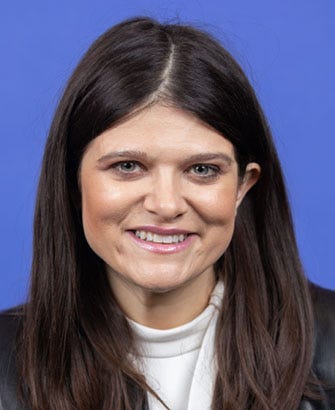
If Haley Stevens is to be believed, Abdul El-Sayed, Michigan’s newly elected Democratic senator and her onetime primary opponent, has trafficked in antisemitism. In an interview with CNN’s Anderson Cooper on Sunday, she said, “I think some of [his] actions have certainly been antisemitic, Anderson, but I’m just sick of who he stands with.”
El-Sayed has fiercely criticized Israel. He has rejected its right to exist as what he calls an “ethno-state,” one that denies rights to non-Jews under its control (a position many Jews share, including me).
But as far as I can tell, nothing he has said or done conveys animus toward Jews as Jews, which is the prerequisite for calling something antisemitic. By contrast, some of his most prominent detractors have themselves reinforced antisemitic tropes, Stevens included.
Like Netanyahu and AIPAC, Stevens is validating antisemitic tropes and enabling the Republican assault on America.
One El-Sayed talking point that critics have seized on is his claim that Israel is responsible for rising fuel prices. Specifically, he alleges that Netanyahu pushed Donald Trump into war with Iran, sending prices soaring.
The notion of powerful Jews pulling the strings of world powers is an age-old antisemitic conspiracy theory. In this case, however, the claim has a basis in reality.
As reporting by the New York Times, Axios, and Reuters has shown, Netanyahu did play a major role in persuading Trump to go to war. A crucial moment came on February 11, when he briefed Trump and his top advisers in the White House Situation Room. During the presentation, the Israeli leader spun wild fantasies about how a joint U.S.-Israeli attack could incite a popular uprising against the Iranian regime and see the ayatollah replaced by a secular leader.
CIA Director John Ratcliffe called these scenarios “farcical,” and Secretary of State Marco Rubio dismissed them as “bullshit.” Nevertheless, Netanyahu’s presentation was “pivotal in setting the United States and Israel on the path toward a major armed conflict,” according to the Times.
Israel affected Trump’s decision in another way as well. On March 2, Rubio said the U.S. launched its assault because officials “knew that there was going to be an Israeli action,” which would likely prompt Iranian retaliation against U.S. targets. (Trump disputed this the next day, for what that’s worth, saying, “If anything, I might have forced Israel’s hand.”)
Trump did not exactly need Netanyahu’s encouragement to take a belligerent stance toward Iran. But when El-Sayed attributes rising fuel prices to Israeli influence, he has a point; the Israeli prime minister helped convince Trump that war was necessary, and the war is the chief cause of the price increases.
As someone who claims to be concerned about antisemitism, Stevens might have criticized Netanyahu for validating a notorious anti-Jewish smear. Instead, she attacked her Muslim primary opponent for linking Israel to rising costs—a link that holds up, at least where fuel prices are concerned.
Nor was that the only antisemitic trope Stevens chose to overlook. The American Israel Public Affairs Committee (AIPAC), a pro-Israel lobby group, has long marshaled large sums of campaign money to support candidates who back Israel and defeat those who do not. Stevens’s own primary was an especially glaring example: AIPAC’s super PAC, the United Democracy Project, accounted for roughly half of the more than $60 million in outside spending to help her win.
If Stevens were genuinely worried about antisemitism, she might have called out AIPAC for lending credence to the stereotype of wealthy Jews using their money to advance Israel’s agenda. Rather, she went after El-Sayed for pointing out AIPAC’s role. Worse, she told him that “everyone in America understands you want to blame all of your problems on Jewish Americans,” thereby making a classic antisemitic move of her own: conflating Jewish Americans as a whole with an influential pro-Israel advocacy group.
This week, Stevens is again in the news after withdrawing her support for El-Sayed and endorsing Mike Rogers, his Republican opponent. This is a guy whom Stevens previously accused of “getting rich off his position of power,” helping “kick off the opioid crisis,” “letting Big Pharma rip off Michiganders,” backing “even more tax cuts for the ultra-wealthy,” and amassing a “terrible record on abortion rights” and a “repulsive” record on LGBTQ+ rights.
To that, we might add Rogers’s refusal to disavow Trump’s anti-Muslim attacks on El-Sayed, as well as his own false or unsupported claims linking El-Sayed to Islamist terrorist groups and his shameless insinuations about El-Sayed’s loyalty.
What’s more, some of the people Rogers “stands with,” as Stevens might put it, espouse wretched beliefs, including on the one issue Stevens ostensibly cares most about: antisemitism. This spring, Rogers announced a “Students for Mike Rogers” outreach team. One member, University of Michigan student Alexander Richmond, had defended Young Republicans who praised Hitler and joked about gas chambers in a leaked group chat. Another, Cameron Dundas of Northwestern Michigan College, had responded to a post asking what should be done about “these people” (an apparent reference to Jews) by suggesting that they be sent to North Korea.
Stevens noticed at the time. “Yet again, Mike Rogers shows us exactly who he is by who he chooses to represent his campaign,” she wrote in April. “This is disgraceful, especially amidst rising antisemitism across the country.”
The only decent move on Rogers’s part would have been to put the two aspiring Stabsführer out to pasture and apologize. Considering that decency is about as popular as syphilis among Republican operatives these days, that was a bit more than could have been expected of him. Instead, Rogers’s campaign brushed off the criticism, saying its volunteers have “varying view points [sic].” Those “view points” evidently include rounding up Jews like some edgelord Gestapo.
By endorsing Rogers, Stevens is effectively saying that none of these things is a big deal, at least compared to the issue she seems to privilege above all else: Israel. Rogers supports Israel, while El-Sayed does not. For her, that appears to be all that matters.
Yet by placing Israel over country and Constitution and, in the process, trashing every value she professes to hold, the congresswoman is breathing new life into yet another antisemitic canard: that support for Israel comes before loyalty to America.
To be clear, I am not accusing Stevens herself of antisemitism. Antisemitism requires animus toward Jews, which she clearly does not harbor.
But I am accusing her of being a dangerous idiot. Like Netanyahu and AIPAC, she is validating antisemitic tropes and enabling the Republican assault on America. Stevens says she is sick of who El-Sayed stands with. Michiganders might say the same of her.
Banana