

“I do not ask that you place hands upon the tyrant to topple him over, but simply that you support him no longer; then you will behold him, like a great Colossus whose pedestal has been pulled away, fall of his own weight and break into pieces.”
—Étienne de La Boétie, Discourse on Voluntary Servitude, 1577
“The whole place is gonna go. It’s gonna pop like a cork.”
—TIME correspondent, Manila, August 21st, 1983
Forty years ago today, Filipinos came face to face with the machinery of death that once cowed and terrorized them.
Weeks earlier, Ferdinand Marcos, who for decades had ruled the country as his personal dominion, lost his bid for another presidential term. But he was determined as ever to remain in charge.
On February 23rd, 1986, a Sunday, he ordered his military to assault a band of renegade army officers holed up in a nearby base.
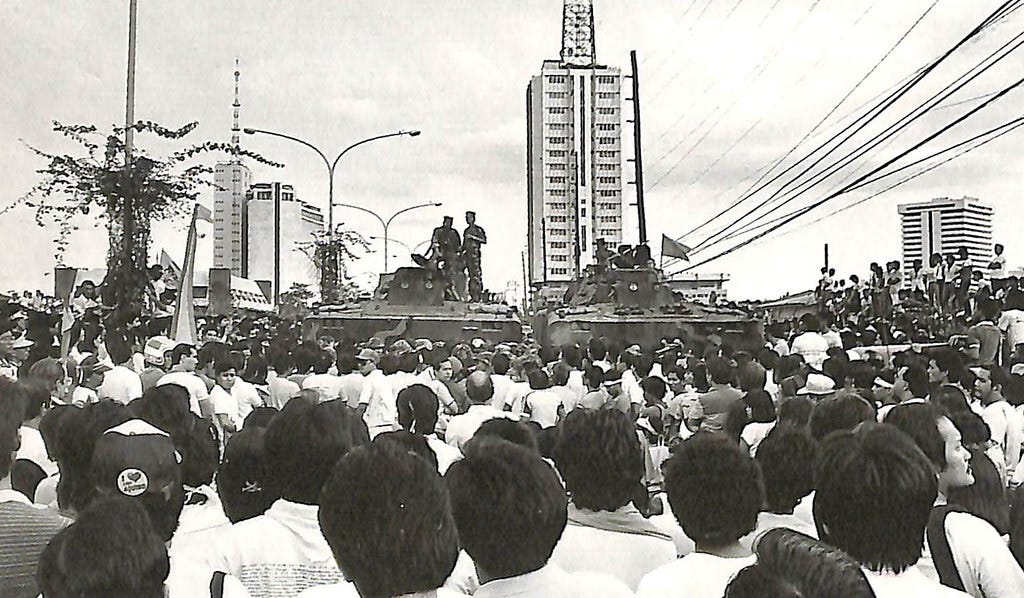
As his tanks rolled down Epifanio de los Santos Avenue in Manila, they came upon 20,000 Filipinos occupying the eight-lane boulevard, intent on stopping them from reaching their target. If previously, the people had trembled at the thought of resisting, now, they stood firm.
Amado Lacuesta Jr., a young screenwriter present near the front of the throng, described the encounter:
Panic sweeps over us all. Unthinking, I drop to my knees. Looking up I see only the general and his marines, disciplined, hard-eyed. … I shout and raise my hands, daring them: “Go on, kill us!” … The metal mountain jerks forward. Defiant, nervous shouts all around. The praying voices rise another key. I wonder what it is like to be crushed under tons of metal. Then the engine stops. There is an astounding split second of silence. The crowd erupts into wild cheers and applause.
Ordered to slaughter innocents, the troops had refused. “There were pregnant women and little children there that reminded us of our own families,” one soldier recounts. “I knew that if I didn’t clear the road and follow orders, I would be shot. But I also knew that if I did that, I would have to violate my conscience.”
The confrontation that Sunday was a critical moment, one of several which saw a bloody dictatorship dissolve in a matter of days.
In a test of wills, Filipinos had stared down a ruthless strongman—and won.
The Fortress and the Temple
It might seem counterintuitive to see dictators as vulnerable to the fickle allegiances of others. It is certainly not how dictators see themselves.
Conventional wisdom views power as a fortress—strong, fixed, and durable. A ruler has police and soldiers, and he1 uses them to exert his will upon society. The only way to thwart his power is to destroy it with superior force or take control of it in an election or coup.
But this is not how power actually works. Recall the example of Vidkun Quisling, the wartime Nazi puppet leader of Norway, whom I discussed in a previous essay. For all the terror he employed, he was unable to bring a bunch of recalcitrant schoolteachers into line.
The Norwegian teachers’ resistance lays bare the misconception behind the fortress view. In the absence of voluntary compliance, no amount of force can make someone obey another’s command.
Power, in other words, is not something that rulers have; it is granted to them by others.
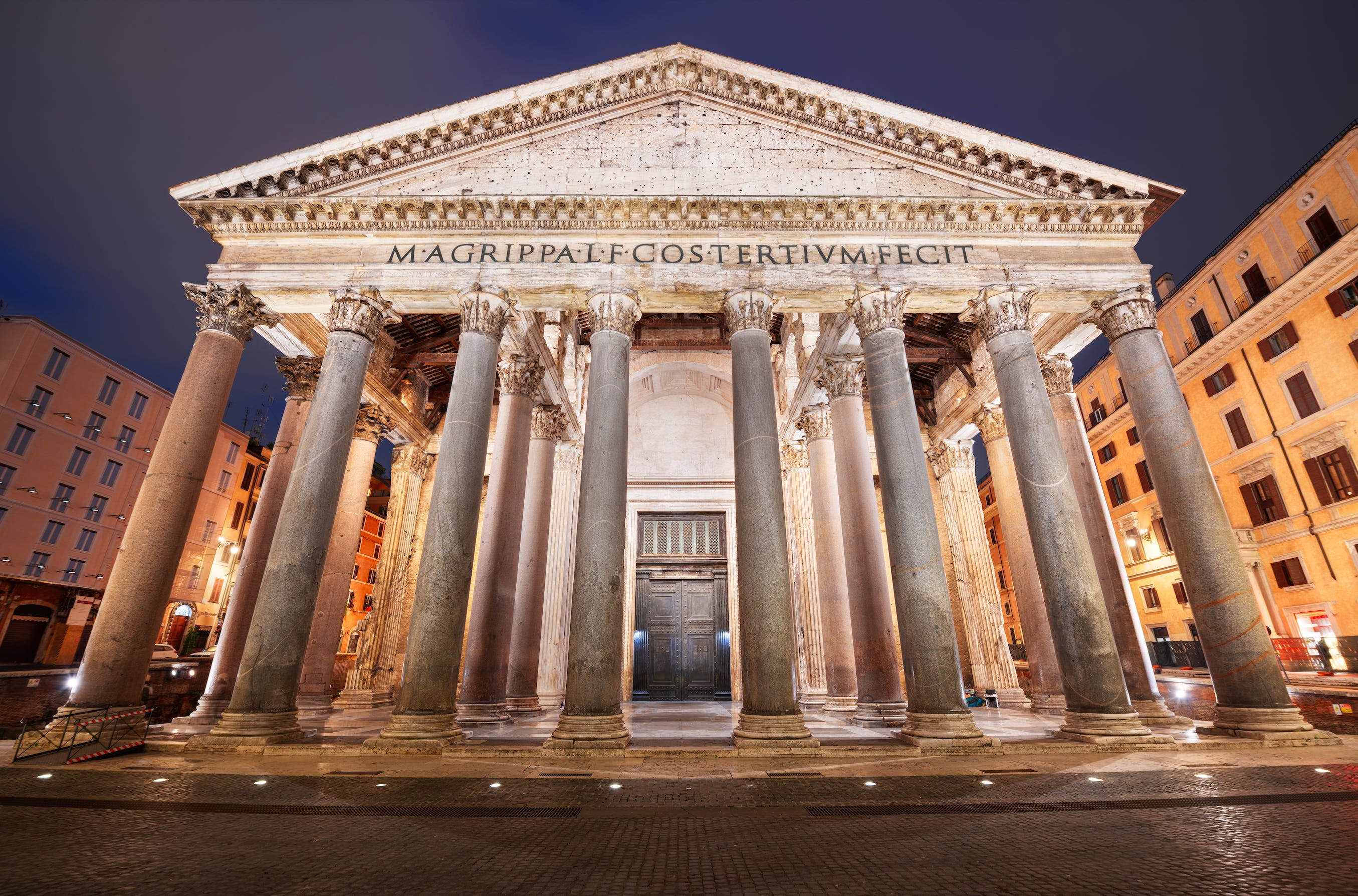
In this regard, power is more accurately viewed as a temple than a fortress. The Pantheon in Rome would not remain upright without the support of its columns, or pillars. Topple those pillars and watch it collapse.
The model of a temple on pillars is useful, for it highlights just how brittle power can be. “When we say of somebody that he is ‘in power,’” notes Hannah Arendt in On Violence,
we actually refer to his being empowered by a certain number of people to act in their name. The moment the group, from which the power originated to begin with…disappears, “his power” also vanishes.
This principle applies regardless of whether the ruler operates in a democracy or dictatorship. Of course, given the dystopian hellscape in which the United States now finds itself, it is the dictator that most concerns us here.
Like any powerholder, the dictator is just one person. To remain in power and enforce his directives, he needs the support of a whole range of elites. These elites are the pillars that prop up his regime.
The most obvious ones are the military and police. But other pillars can include prominent businesspeople, government officials, civil servants, pro-government parties, state media, religious authorities, and foreign allies.
Nonviolent action creates the opportunity—and, often, necessity—for the ruler’s supporting pillars to cut and run, leaving him bereft of the agents he depends on to wield control.
Most dictators can withstand the loss of one or another pillar. Remove several, and he begins to sweat. Remove the army, police, and other armed elements, and he is finished.
The question, from the standpoint of his beleaguered subjects, is how to sweep those pillars away. There are several methods, not all of them desirable. For instance, a military coup removes a crucial pillar of support, but it might end up yielding a new dictator in place of the old.
If our goal is the return of democracy, then mass nonviolent action is the most effective way of dislodging an autocrat. Protests, strikes, boycotts, and other forms of nonviolent resistance, if waged on a sufficiently large scale, call into question a dictator’s survival. At that point, the elites who serve as pillars of his regime might decide that it is time to abandon him.
When they do defect, it is rarely because they experience a moral revelation about how bad the dictator is. More often, their motivations are selfish. Some elites defect because they fear being held accountable if the regime falls. Others foresee an opportunity for advantage.
Whatever their agenda, the outcome is the same. Few dictators can survive the mass desertion of their elite supporters—and the best means of driving those elites away is through popular nonviolent resistance.
Nonviolent action creates the opportunity—and, often, necessity—for the ruler’s supporting pillars to cut and run, leaving him bereft of the agents he depends on to wield control.
The question of which model to adopt is hardly theoretical. For those living under authoritarianism, the implications are very real.
If we accept the fortress view, then there is little point in opposing the regime. Unless resisters can mount their own army, the dictator remains secure.
Embracing the temple view, by contrast, opens up a more liberating possibility: control of the ruler by the “withdrawal of consent.” As Gene Sharp explains:
It is control, not by the infliction of superior violence from on top or outside, not by persuasion, nor by hopes of a change of heart in the ruler, but rather by the subjects’ declining to supply the power-holder with the sources of his power, by cutting off his power at the roots. This is resistance by noncooperation and disobedience.
In addition to being accurate, the temple model has the complementary advantage of putting the people in the driver’s seat. Popular resistance erodes the foundation of the ruler’s temple, destabilizing its supporting pillars. Shake those pillars enough, and his power collapses.
Few cases better illustrate this dynamic than the downfall of Philippine strongman Ferdinand Marcos in February 1986.
The Conjugal Dictatorship
In the years following his initial election as president in 1965, Marcos did not especially stand out from his predecessors.
It was his reelection campaign in 1969 which first showcased the tyranny that was to come. As the campaign heated up, Marcos dispatched his thugs to terrorize the opposition and strong-arm election officials, making the contest the bloodiest to date.
The election presaged a dark turn in his presidency. As popular unrest spiraled and his popularity tanked, Marcos became increasingly despotic.
In 1972, he ripped away all democratic pretense by declaring martial law. Officially aimed at containing the growing communist insurgency, it was a convenient excuse to cancel the election slated for the following year, in which he faced near-certain defeat.
With martial law in effect, there would be no election to lose and no parliament or supreme court to meddle in his affairs. From now on, Marcos would rule by decree. He shuttered independent media and unleashed the military on activists, journalists, professors, and political rivals, jailing thousands in a matter of weeks.
Still, he had to somehow justify the shift to one-man rule, and propaganda alone would not suffice. Nor were ordinary Filipinos the only ones who needed convincing. As the Philippines’ most important ally, the United States had to be brought on board.
But how? If there were an emergency, perhaps—a crisis so grave as to be immune to conventional remedies—that would certainly do.
There was a problem, however: No such emergency existed. And so, Marcos invented one.
In the months before the declaration of martial law, downtown Manila was rocked by a series of bombings. The regime blamed the communist rebels. In truth, Marcos’s own agents were responsible.
The charade was enough to convince Filipinos—and, critically, Americans—to accept the new order.
By the early 1980s, however, the country had plunged into crisis. The foreign borrowing spree which kept the Marcos regime afloat had become unsustainable, and the 1981 collapse of a major financial scam triggered a banking panic. The economy cratered. Poverty spiked.
Not everyone suffered, naturally. Marcos spent $3 billion on bailouts for his oligarch friends. For her part, Imelda Marcos, the first lady, was not about to skimp on her lavish shopping sprees in Paris and New York.
At a time of belt-tightening, such barefaced graft was sure to fuel resentment. But few Filipinos were prepared to brave the hazards of challenging the regime. As far as most were concerned, Marcos was protected by his army and police. Who, under the circumstances, would risk their necks by speaking out?
In this way, most of the public remained blinded by the fortress myth. “The regime lasted for twenty years,” observes Sterling Seagrave, a journalist, “only because
Filipinos allowed themselves to be convinced that the dictator was in firm control, that his secret police were everywhere, that his army was overwhelmingly powerful, and that Ferdinand Marcos himself was supernaturally endowed. These things were true up to a point. Beyond that, the impression of power and omniscience was exaggerated by showmanship and grotesque extremes of cruelty. Ordinary people were psyched out.
State intimidation was undoubtedly one of the keys to Marcos’s rule. During his twenty-year tenure, approximately 35,000 people were tortured and 70,000 arrested, historian Alfred W. McCoy estimates. Such was the barbarism of Marcos’s torture units that a new word was invented to describe it: “salvaging,” or the disposal of mutilated corpses along roadsides for the purpose of sowing terror.
But as Seagrave notes, force alone was not enough to keep the people down. Equally important, and more cost-effective, was the belief in the ruler’s invincibility.
The Marcoses wrapped their dominance in a shroud of performance and myth. Imelda hailed from one of the Philippines’ most noble houses. Ferdinand descended from great warriors. He was also an Olympic athlete. And he bravely led a band of guerillas against Japanese rule during the Second World War, in recognition of which he was awarded the Medal of Honor by Douglas MacArthur himself.
(In 1985, a rather inconvenient time for Marcos, a U.S. military investigation deemed his claim to have led a guerilla unit, much less receive a medal for it, as “fraudulent” and “absurd”).
Imelda claimed that General MacArthur had secretly adopted her as a young girl. That very same MacArthur carried on an illicit love affair with her aunt. (To a certain generation of Filipinos, MacArthur embodied a sort of hybrid between Alexander the Great and Taylor Swift.)
It was all bullshit, and most people knew it. But that was the point: Only those as omnipotent as the Marcoses could lie so brazenly without consequence.
The Marcos dictatorship was very much a family affair. Imelda represented the country on the international stage. Back home, she served as “minister of human settlements,” tasked with dispensing patronage to Ferdinand’s provincial allies.
For the ruling couple, the experience of martial law was like the “Push It to the Limit” montage in Scarface, if Florida were a nation-state ruled by Al Pacino and Michelle Pfeiffer. The misrule would have been comical if not for the human costs it entailed.
The Marcoses emptied an entire island of its inhabitants to make way for a private zoo complete with giraffes, zebras, and other wildlife imported from Kenya. Imelda lavished $31 million on a “grotesque guesthouse made entirely of coconuts.”
The presidential palace boasted an oversized painting featuring the ruling couple as the Filipino Adam and Eve, giving birth to the nation. According to Keith Dalton, a reporter who saw it first-hand, the portrait depicted a “muscular, bare chested, dagger-holding Marcos emerging from a bamboo jungle, and a half naked, long-haired, coy-looking Imelda modestly clutching a flowing white veil to her chest.”
But while the dictator believes he resides in Dragonstone, events have a way of revealing otherwise—that he is really standing on top of the Pantheon. The veil, godlike though it seems, can be pierced in an instant.
For the Marcoses, that moment came on August 21st, 1983.
The Cork Pops
On the flight to Manila, Ninoy’s mood alternated between tense and serene.
That morning, he boarded a Boeing 767 en route from Taiwan. Clad in the same white suit he wore the day he left the Philippines three years earlier, he passed the time chatting amicably with his entourage and the retinue of journalists accompanying him.
One of those reporters was Sandra Burton, whose narrative of the event provides the basis for its retelling here.
Burton spoke extensively with Ninoy during the trip. “They say the guy is stupid to go home,” he told her, referring to himself in the third-person. “They don’t understand the value of self-sacrifice. Gandhi kneeling down and getting bashed. The vanquished is the victor. If you can get at the bad thing within your enemy, you unmask him.”
The plane begins its approach. Through the window, Ninoy catches sight of the verdant mountains of northern Luzon. “I’m home,” he declares elatedly.
A stewardess grabs the microphone. “At twelve-forty-five P.M., it is eighty-eight degrees Fahrenheit in Manila. We hope you have enjoyed your flight and will fly again soon with China Airlines.”
The cabin crew approaches to wish Ninoy well.
“1:04 P.M., touchdown,” Burton writes in her notebook. “Machine guns and tanks near the terminal.”
The plane rolls to a stop. The pilot comes on the loudspeaker. “Please remain in your seats for ten minutes.”
Through the window, a blue van can be seen backing up to the stairs leading from the jet bridge to the tarmac.
Three soldiers enter the plane and start down the aisle. After spotting Ninoy, they help him up, grab his bag, and escort him to the exit door.
As soon as they leave, the remaining passengers line up, waiting to disembark.
Voices can be heard from the jet bridge:
Person 1: I’ll do it!
Person 2: They can have it!
Person 3: Get down, get down!
Then, from just outside the service door to the tarmac, a loud pop.
TIME correspondent: What happened? What was that?
Three more shots. A female passenger screams. Another pop.
TIME correspondent: Wait. What happened? Oh no, he’s…
Female passenger: Oh no [wails]
ABC-TV correspondent: What happened?
TIME correspondent: The soldiers…they put about sixteen shots in him. They shot Ninoy. He’s dead out there. Christ, almighty…
A team of SWAT commandos stands on the tarmac, guns aimed at the passengers as they descend the stairs. A few of the soldiers approach Ninoy’s body as it lies lifeless on the ground. They pick it up and fling it into the blue van. Then, they jump in the back, and the van speeds off.
Left behind is a second man, dead in a pool of blood.
TIME correspondent: Does anybody know what those uniforms were?
Japanese reporter: They pretend that this guy killed him…Goddamn Philippines.
TIME correspondent: The whole place is gonna go. It’s gonna pop like a cork.
Fatal Delusion
Known affectionately as “Ninoy,” Benigno Aquino was outgoing and charismatic. He could “sway crowds like a snake charmer,” Burton recalls.
Though born into one of the Philippines’ most privileged families, he was taught from a young age to help those in need. The emphasis on charity was unusual for someone of his class. It would later serve him well as a politician, helping him cultivate a man-of-the-people image.
As governor of one of the only provinces not under Marcos’s control, Aquino was arrested soon after martial law was declared in 1972. He spent the rest of the decade languishing in prison. Under American pressure, he was released into exile in the U.S. in 1980. There, he remained for three years before returning that fateful day in August 1983, his mind set on a political comeback.
As Marcos gazed upon the image of Ninoy’s bullet-riddled corpse, he surely believed that his fortress of power had been strengthened. After all, he had just rid himself of his longtime nemesis and primary electoral threat. Unless somebody could destroy his fortress with a superior army or take control of it in a coup, he was protected.
Little did he know, he was living in a mirage.
Marcos did not reside in a fortress at all, it turns out. Instead, he was sitting on the roof of a temple. And the ground beneath had just begun to shake.
Tremors in the Temple
“I want people to see what they did to my son,” roared a furious Aurora Aquino.
Even in grief, her political savvy was evident. There would be no closed casket. The public would bear witness to her son’s disfigured corpse, dressed in the same blood-drenched suit he wore the day of his murder—a grisly testament to the crime, an accusation embodied in flesh.
The funeral, his mother declared, marked Ninoy’s “resurrection,” a fitting postscript to his “crucifixion” on the airport tarmac. Aurora instinctively grasped the sort of imagery which resonated in the devoutly Catholic Philippines.
As the coffin made its way through the streets of Manila, more than a million onlookers gathered to watch. The color yellow, long associated with the Aquino family, was visible everywhere—on clothing, banners, ribbons, flowers.
While no one knew it at the time, Ninoy’s procession marked the starting gun of a movement. For the next three years, Manila was the scene of strikes, demonstrations, and other forms of nonviolent resistance that would eventually force the Marcoses into exile.
Marcos’s allies had a choice to make: stay loyal to the president and risk facing accountability, or switch their allegiance to Cory, the legitimate president-elect. For them, it was about self-preservation.
Just as unexpected as the movement itself was the person who emerged at its head: Ninoy’s widow, Corazon.
Although the role had largely been thrust upon her, Cory, as she was known, turned out to be more than her husband’s equal when it came to moving a crowd. “It seemed,” writes Stanley Karnow, author of the Pulitzer Prize-winning In Our Image: America’s Empire in the Philippines, that she “was in direct communion with the people, projecting an aura of sanctity that almost mesmerized devout Filipinos.”
In time, most of the country’s fractious opposition would unite behind her.
Far from demoralizing Filipinos, the ruthless violence that Marcos meted out in response only emboldened them. The 1984 parliamentary elections drew a turnout of ninety percent. Parties backed by Cory surmounted colossal fraud and intimidation to win a third of the seats.
The following year, in February 1985, the assassination of a labor leader sparked a general strike. That same month saw thousands of farmers embark on a 200-mile trek from Luzon to Manila to hold a nine-day sit-in outside the agriculture ministry.
Further inflaming public anger was the sham verdict in the trial of Ninoy’s assassins. In December 1985, army chief Fabian Ver, a Marcos loyalist and the country’s second most powerful figure, was acquitted with his co-conspirators of planning and executing the murder.
The First Pillars Give Way
Marcos’s repression was clearly backfiring. With every arrest, beating, and killing, the resistance grew, and he was powerless to stop it.
The veil of invincibility had been lifted, revealing an embittered and impotent man lashing out in futility.
Now that the end of his rule seemed like a real possibility, his erstwhile allies began to reassess their support.
The Catholic Church had never backed the regime outright. But in a country as devout as the Philippines, the clergy held considerable sway. At the very least, it was imperative for Marcos that they remain acquiescent.
Yet, the routine torture and murder of clergy members did not exactly help his cause. As the abuses mounted, many became vocal opponents.
Chief among these critics was Cardinal Jaime Sin, the country’s highest ranking church figure. Sin would play a key role in Marcos’s downfall. A skilled organizer and communicator, he was more responsible than anyone save Cory Aquino for uniting the opposition. Under his leadership, the church trained thousands of volunteer election monitors as well.
In addition, the church-owned Radio Veritas was far and away the country’s most important independent media outlet. As the resistance gained force, Radio Veritas served as both a critical source of information and a coordinator of mass action.
More important still were the nuns. It was they who stood between the demonstrators and the soldiers, calming jittery nerves and keeping both sides peaceful. “When the tanks started to move, they didn’t budge,” recalls one observer. “They just kept praying.”
While the clergy acted on principle, others saw in the burgeoning movement a chance to gain advantage.
Marcos’s corrupt predation and economic mismanagement had already alienated most of the business elite. During martial law, he subjected scores of businesspeople to sham prosecutions, which he used as pretexts to seize their assets and gift them to his cronies in exchange for kickbacks.
Thanks to such schemes, Marcos amassed a fortune worth at least $10 billion dollars by the end of his presidency, which he stashed away in a maze of bank accounts and properties in Switzerland, Hong Kong, and the U.S.
Adding insult to injury were his multibillion-dollar bailouts of these same cronies once the economic crisis of the early 1980s hit, even as traditional business elites saw their fortunes crater.
In 1981, a collection of business executives formed the Makati Business Club, which would serve as an advocacy group to press for their interests. At the same time, most businesspeople steered clear of overt opposition to the regime.
Ninoy’s assassination was the breaking point. It not only showed that their own lives were expendable, but the resulting surge in popular resistance convinced them that Marcos could be defeated. From 1983 onwards, the Makati Business Club poured its resources into the opposition movement.
On their own, the clergy and business community lacked the heft to threaten the regime, whose weightier pillars remained standing. In February 1986, these other pillars would fall, too, taking Marcos with them.
A Forced Choice
Dictators would survive much longer but for one common flaw: Eventually, they start to believe their own bullshit.
At the same time that First Lady Imelda was lecturing her courtiers about a “cosmic vision of development,” she was raiding a typhoon relief fund to pay for her daughter’s wedding.
Ferdinand was equally oblivious. “His corrupt administration was totally discredited by late 1985,” Karnow writes, “yet his blind belief in his own invincibility prompted him to schedule the election against Cory Aquino that spelled his doom.”
High on his own supply, Marcos called the snap poll for February 7th, 1986, certain that he could fraud his way to victory just as he had in the past.
He failed to understand just how fundamentally the country’s politics had changed. Through the experience of civil resistance, a public that was once overawed by his intimidation and propaganda had become cognizant of its own power.
Filipinos were about to seize the future for themselves. In the process, they would drag down the remaining pillars that kept his temple standing.
With little time to lose, the opposition quickly united behind Cory Aquino. Marcos and his thugs, for their part, drew generously from their ratfucking repertoire, stuffing ballot boxes and unleashing wanton violence.
This time, it would not work. Two days after the voting ended, on February 9th, the computer technicians responsible for tallying the votes walked off the job in protest at the ongoing fraud. Another pillar had fallen.
Days later, on the fourteenth, over a hundred Catholic bishops denounced the “unparalleled” election violations, proclaiming Marcos’s bid to remain president as having “no moral basis.”
When the parliament, stacked with pro-government loyalists, declared Marcos the winner the next day, the opposition walked out.
The sixteenth brought one of the revolution’s pivotal events. Two million Filipinos gathered at Manila’s Luneta Park to hear Cory Aquino speak. The sheer size of the turnout was an unmistakable sign that Philippine society, or a massive part thereof, rejected Marcos’s legitimacy.
For the first time in twenty years, the prospect of his downfall went from distant possibility to imminent prospect.
In her address, Aquino called for a nationwide campaign of civil disobedience, to include mass demonstrations and boycotts of businesses, banks, and media outlets that supported the president.
Any allies who remained by Marcos’s side now had a choice to make. They could stay loyal to the president and risk facing accountability if he fell. Alternatively, they could switch their allegiance to Cory, the legitimate president-elect, and retain some chance of maintaining their influence and freedom once she took over.
Morality, for them, had nothing to do with it. This was about self-preservation. And it was thanks to the courage of everyday Filipinos that they faced this dilemma in the first place.
Enrile’s Confession
“I’ll be dead in an hour,” said the voice on the other end of the line.
It was less a prediction than a plea. The man who issued it, defense minister Juan Ponce Enrile, was in a world of trouble.
On February 22nd, 1986, at around three o’clock in the afternoon, Enrile placed a frantic call to Villa San Miguel, the residence of Cardinal Sin.
“Your Eminence,” he implored, “please help us. The president’s men are coming to arrest us.”
In the weeks since the presidential election, the world’s attention had been fixated on which of the two candidates would emerge victorious.
But Enrile had other plans. Together with Lt. General Fidel Ramos, the army vice chief of staff, he led a renegade faction of army officers, the Reform the Armed Forces Movement, known as RAM for short.
If it were up to them, there would be no President Marcos and no President Aquino, but a President Enrile. And they were going to do something about it.
Everything was set. The coup would take place at dawn on Sunday, February 23rd. Attacking from four directions, a RAM contingent would place the presidential palace under siege. At that point, another group would storm the residence, make a beeline for the master bedroom, and arrest the president and first lady. Then, they would announce to the nation that a military-led junta had taken charge.
The officers claimed that they were driven by outrage over rampant criminality and corruption in the military.
Such grandstanding was rather precious given the unsavory reputations of RAM’S leading members.
Consider some examples:
Lt. Vic Batac, who stood accused by an international commission of torturing a woman using “electric shock, water cure, sleep deprivation, sexual indignities, pistol whipping and threats to relatives.”
Lt. Rodolfo Aguinaldo, a “persistent and systematic torturer,” according to a Philippine rights organization.
Lt. Col. Gregorio Honasan, aka “Gringo,” implicated in “the brutal slaying of a dissident, Dr. Johnny Escandor, whose body was found dumped outside military headquarters in Manila, the brain removed from his skull and underpants stuffed in the cavity.”
Lt. Gen. Ramos, who, as head of the notorious Constabulary, had overseen the horrific abuses just described.
Finally, there was Enrile, the prime orchestrator behind martial law. Aside from terror, his other specialty was graft. Enrile was rumored to be the country’s third wealthiest man. This would have made him a billionaire—not bad for a guy on a government salary.
Considering the sorts of characters who made up RAM, it strains credulity to believe that they were acting out of moral indignation. These men had lost the right to be offended by anything.
The truth was far more banal: The officers were resentful at having been pushed aside by Marcos’s cronies—and they would now take back what was rightfully theirs.
There was a problem, however: Marcos had been tipped off to their plan and moved quickly to thwart it. A marine battalion was brought in to reinforce the palace, making it a death trap for any attackers. Worse, some of the key plotters were arrested just before the coup was to go into effect.
Forced onto the back foot, Ramos, Enrile, and the remaining RAM officers retreated to Camp Aguinaldo, the headquarters of the defense ministry, and Camp Crame, the seat of the national police. Both stood opposite one another on the eight-lane Epifanio de los Santos Avenue in Manila.
Marcos, who still controlled the bulk of the armed forces, was widely expected to order an assault on the rebel officers.
With no chance of overthrowing the president by force, their only hope was to call on the rest of the army to join their ranks—and rely on the crowds to defend them.
If they could somehow bring thousands of Filipinos onto the boulevard, the human mass could serve as a buffer against the president’s forces.
Without that, the RAM officers would be crushed—and everyone knew it. “A half-dozen shells and a few good strafing runs and we’re all dead,” affirmed one of Enrile’s colonels.
But there was a hitch: How to convince the people to risk their necks for a bunch of military officers with blood on their hands?
There was only one thing to do: place the call to Cardinal Sin. And so, in the evening of February 22nd, that is exactly what Enrile did.
Sin, whose moral authority was matched by his political astuteness, immediately recognized the opportunity. The RAM officers would work their military networks to convince additional units to defect, while Sin would summon the faithful to their defense.
Even with Sin’s support, however, it would be a tall order to persuade Filipinos to rally behind their erstwhile torturers.
Hence, in an “act of contrition,” the two RAM leaders called a press conference for later that Saturday. There, seated beside Ramos, a visibly shaking Enrile announced his wish to atone for his crimes.
Well, maybe not all of them; now that he’s on the pyre, there’s no need to help pour the gasoline. But he did mention a few—his “participation in the declaration of martial law” and his more recent role in helping to rig the election in Marcos’s favor.
If only he’d known those sorts of things were frowned upon…
Ramos was somewhat less contrite, directing his fury at Marcos and his associates instead. The armed forces had become “immoral,” claimed the man who oversaw the use of electric shocks on the genitals of torture victims.
The performance was far from ideal. But the officers could still be useful to the revolution. For Cardinal Sin, that was enough.
Officers Schooled
Just hours before that fateful call, the RAM officers had been looking forward to a successful coup. Now, they were desperate, hoping against hope that their military colleagues would break ranks while ordinary Filipinos would come to their rescue.
In fact, the officers had just undergone a crash course in the nature of power. They had long been taught to see power as a fortress, insulated from the trivial concerns of everyday citizens. The only way to seize it, in this view, was to assemble a military force that could overwhelm the ruler’s—exactly what they had planned to do in their coup.
But as they discovered, a coup is not the only or even most reliable way to oust a dictator. So, when the plot failed, they underwent a conversion. Very quickly, they came to understand that power is not at all like a fortress. It is more akin to a temple, which cannot stand without the support of its massive pillars.
As we saw above, Marcos had already lost some of these pillars long before the election took place: the Catholic clergy, for one, and the business community, for another. After the polls closed, he lost a third: the state election experts responsible for tallying the votes, who were now in open revolt over the fraud they had been asked to perpetrate.
But the most crucial pillars remained in his grasp—the military, first and foremost. The RAM officers only comprised a tiny portion of the armed forces, whose ranks, at this point, remained overwhelmingly loyal to the president.
The question was how to convince the rest of the army to defect. It would take a lot more than promises and sweet-talking. Defying the president was an act of treason. For the soldiers who were still aligned with the regime, this was not a decision to take lightly.
For them, there was only one thing that could make the risk of defecting more tolerable. If the troops, commanders, and top brass could see that Marcos had lost his authority over the people, it would alter their calculus. Going against a ruler whose days were numbered was a different matter entirely than defying one who might remain in power indefinitely.
Under those circumstances, in fact, the incentives would be reversed. If Marcos really was on his way out, his troops would have every reason to switch sides at the earliest opportunity—if only to avoid being implicated in any further crackdowns. After all, a new regime was on the horizon—and with it, the prospect of accountability.
Standing Down
Following Enrile and Ramos’s confession, Sin issued a public appeal to “support our two good friends.”
The effect was astounding. “By sunrise Sunday, the entire eight-lane width of Efran de Los Santos Street was choked with humanity,” reported Mark Fineman of the Los Angeles Times.
It was here, on the road to camps Crame and Aguinaldo, that masses of Filipinos confronted the regime’s armored columns. Epifanio de los Santos Avenue was now the key battleground in the struggle for the country’s future, and its acronym, EDSA, would become synonymous with the revolution.
For the next three days, EDSA was a giant festival grounds host to singing, dancing, and prayer vigils. At its peak, an estimated two million Filipinos—men and women, young and old, healthy and infirm—endured the threat of bloodshed to defend the rebel officers from Marcos’s troops.
Standing face-to-face with soldiers ordered to slaughter them, the demonstrators offered “flowers, chocolates, [and] prayers,” inviting them to switch sides and join the resistance.
Through the experience of civil resistance, a public that was once overawed by his intimidation and propaganda had become cognizant of its own power.
“Stop! I am an old woman,” pleaded a wheelchair-bound protester in front of an armored personnel carrier. “You can kill me but don’t kill the young people here.” A moment later, a soldier descended, and they embraced.
Another woman placed her young granddaughter on top of a tank. The child kissed the driver, “and that finished the tank forever,” a witness recalls. “No anti-tank gun ever invented was so effective as that little three-year-old girl.”
Commanded to murder innocents, the soldiers flinched, and the people remained steadfast. “The funny thing about the whole siege,” recounts one participant, “was that all those [troops who were] ordered to attack Camp Crame, even if they were able to get through, ended up defecting to our side before they reached their target.”
During the entire four-day saga, not a single soldier intentionally killed a civilian.
But the wily Marcos had an ace up his sleeve. As it turned out, his most loyal devotee was not in any military command center but an ocean away, in Washington D.C.
America Teeters
“Three centuries in a Catholic convent and fifty years in Hollywood,” goes a common quip about Philippine history.
For three hundred years, the Catholic monarchs of Spain lorded over the Pacific archipelago. When they were not exploiting the people, they were busy converting them, turning the Philippines into Asia’s sole majority-Christian country.
In 1898, after its victory in the Spanish-American War, the United States assumed direct control of the islands. Such outright colonialism was unusual for the U.S., which preferred more informal means of domination. But it explains why American power continued to loom large in the country even after its independence in 1946.
During the Marcos era, America’s overriding concern was to protect its local military bases from a growing communist insurgency. To be sure, Marcos’s pitiless tyranny was responsible for fueling the rebellion in the first place. But U.S. policymakers, as they are wont to do, adopted an ass-backward reading of the conflict, viewing Marcos as the ultimate safeguard against a communist victory.
At the same time, the U.S. needed its strongman to at least pay lip service to human rights so as to avoid breeding opposition to the relationship at home and abroad.
But with Marcos ramping up the repression against Cory’s resistance movement, the fiction had become impossible to maintain. Images of bound, stabbed corpses in shallow graves did not play well on the NBC Nightly News. Congressional investigations were launched. Diplomats and national security officials started to question Marcos’s usefulness.
In this way, mass nonviolent action had laid bare the savage brutality at the regime’s core, making it ever more apparent to both Americans and Filipinos.
Filipinos reminded the world that dictators do not reside in fortresses. They instead sit atop temples, whose pillars can be knocked away.
Yet, there remained one holdout, and that holdout happened to be the president of the United States.
For Ronald Reagan, Marcos was an object of reverence, a State Department official explained. It was as if the Philippine leader were “a hero on a bubble gum card he had collected as a kid.” To Reagan, Marcos was the valiant rebel who had fought against the Japanese in the Second World War, and the gracious leader who had rolled out the red carpet to him and Nancy when he was dispatched to Manila during the Nixon administration.
On the one hand, Marcos’s crimes, by this late date, had become too obvious to ignore. A week after the polls closed, Reagan publicly blamed his Filippino counterpart for the “widespread fraud and violence” that had occurred.
Still, he lacked the stomach to abandon Marcos altogether, even as his advisers were pushing for that very move.
For now, the president stood by his man.
Back in Manila, however, the resistance was taking on a life of its own, and regime defections were mounting as a result. Eventually, it would force even Reagan’s hand.
Downward Spiral
By Monday, February 24th, Marcos’s remaining allies had all but deserted him. His temple of power was on the verge of collapse, its supporting pillars in shambles.
And yet, he continued to play the part. In a nationally televised address, he vowed to “wipe out” his opponents. “If necessary, I will defend this position with all the force at my disposal.”
It was the last time he would speak before a national audience. Just as he announced a state of emergency, the rebels took control of the TV station, cutting him off mid-sentence. The feed switched over to Mel Lopez, an opposition deputy, who informed viewers that Marcos was “no longer the president of the Philippines.”
By this point, Marcos was a dictator in name only. He had lost the state media. He had lost his civil servants. He had even lost his airplane pilots, who, around three-o’clock am on the twenty-fourth, were seen speeding away from the presidential palace.
Most importantly of all, he had lost the military. Earlier that day, the crowds on EDSA beheld the terrifying sight of nine strike helicopters descending overhead. Only instead of assaulting Camp Crame, as they had been ordered to do, Burton writes, “the pilots jumped out, waving white handkerchiefs and flashing the Laban sign,” a symbol of resistance in which the thumb and index finger form an “L” for laban, or “fight.” “The anti-Marcos forces now controlled the skies.”
An attempt that same day to retake Channel Four, now in rebel hands, likewise disintegrated. When the soldiers arrived, they were met by protesters offering them coffee, donuts, and McDonald’s hamburgers. The commander promised to withdraw.
“The number of people still loyal to Marcos was shrinking with the passage of each second,” explain Jim Forest and Nancy Forest in Four Days in February, a book chronicling the regime’s demise. By Monday afternoon, 85 percent of the armed forces had defected to the rebels’ side.
Marcos met his end not at the hands of a superior military force but a society that stopped obeying him.
When the day ended, Marcos stood alone. Even Reagan had to bow to the inevitable. “Attempts to prolong the life of the present regime by violence are futile,” read a White House statement. “A solution to this crisis can only be achieved through a peaceful transition to a new government.”
It was as good as an obituary.
When Marcos saw the announcement in the early morning of February 25th, Manila time, he phoned U.S. Senator Paul Laxalt, who had played a key role in the diplomacy surrounding the crisis. Marcos wanted to be sure that the statement reflected the position of the U.S. government. Karnow describes the exchange:
“Senator,” Marcos pressed, “what do you think? Should I step down?” Laxalt responded without hesitation: “I think you should cut and cut cleanly. I think the time has come.” There was a silence so long that Laxalt, wondering whether they had been disconnected, asked, “Mr. President, are you there?” “Yes,” responded Marcos in a thin voice. “I am so very, very disappointed.”
The next day, Cory Aquino had her swearing-in at the private Club Filipino. Instead of taking power themselves, as they had originally planned, Enrile and Ramos were seated among the attendees. Whatever the two powerbrokers’ ambitions, the Philippine people had their own plans.
An hour later, Marcos held an inauguration for himself behind the fortified walls of the presidential palace. It was a pathetic affair with sparse attendance. His prime minister, who earlier that day had been replaced by a member of the opposition, did not show up. Neither did his vice-presidential candidate.
After wrapping up, the Marcoses and their entourage boarded a small fleet of U.S. military helicopters, which took them to a nearby base. From there, they were flown to Hawaii, where they owned a mansion overlooking Honolulu, part of an extensive U.S. property portfolio unwittingly financed by the Philippine people.
In a final show of loyalty, Reagan had offered them asylum.
Into Pieces
“I do not ask that you place hands upon the tyrant to topple him over, but simply that you support him no longer,” wrote Étienne de La Boétie in 1577. “[T]hen you will behold him, like a great Colossus whose pedestal has been pulled away, fall of his own weight and break into pieces.”
Four centuries later, Filipinos took him up on that advice.
The anti-Marcos revolution introduced a new term to the global lexicon: “people power.” It was both a description of the events and a revelation on the part of everyday citizens—that they, not some self-appointed tyrant, were the ones who controlled their destiny.
Filipinos reminded the world that dictators do not reside in fortresses. They instead sit atop temples, whose pillars can be knocked away.
Gene Sharp explains the difference:
One can see the power of a government as emitted from the few who stand at the pinnacle of command. Or one can see that power, in all governments, as continually rising from many parts of the society.
One can also see power as self-perpetuating, durable, not easily or quickly controlled or destroyed. Or political power can be viewed as fragile, always dependent for its strength and existence upon a replenishment of its sources by the cooperation of…institutions and people—cooperation which may or may not continue.
In February 1986, Filipinos proved which one of these views is correct.
Through strikes, protests, and other methods of nonviolent resistance, the people withdrew their consent to be ruled. As a consequence, the elites who had once served as pillars of Marcos’s regime abandoned him.
Different elites acted for their own reasons—the Catholic clergy out of moral revulsion; the business community to protect its interests; military officers to gain political advantage; ordinary soldiers to avoid complicity; and the U.S. government to secure its bases.
In the final analysis, however, it was mass nonviolent resistance which pushed, pulled, moved, implored, threatened, and enabled those elites to act. By calling into question the regime’s survival, nonviolent action created the opportunity—and, very often, necessity—for the president’s allies to pull their support.
Marcos met his end not at the hands of a superior military force but a society that stopped obeying him. By the simple act of noncompliance, everyday resisters had consigned his regime to ashes.
Americans, pay heed.
SOURCES
Amnesty International. 1976. Report of an Amnesty International Mission to the Republic of the Philippines: 22 November-5 December 1975. Amnesty International Publications.
Arendt, Hannah. 1970. On Violence. Harcourt.
Branigin, William. 1986. “Rebels, Marcos Contest Control of Philippines.” The Washington Post, February 23. https://www.washingtonpost.com/archive/politics/1986/02/24/rebels-marcos-contest-control-of-philippines/2c18fa71-45dc-423f-a3e1-9cd187dec323/, accessed January 15, 2026.
Branigin, William and John Burgess. 1986. “Fraud Charges Multiply in Philippines.” The Washington Post, February 9. https://wapo.st/4qsMGU4, accessed February 10, 2026.
British Broadcasting Corporation. 2006. “From Dictatorship to Democracy.” BBC News, February 14. http://news.bbc.co.uk/2/hi/programmes/documentary_archive/4713466.stm, accessed February 3, 2026.
Burton, Sandra. 1989. Impossible Dream: The Marcoses, the Aquinos, and the Unfinished Revolution. Warner Books.
Chenoweth, Erica and Maria Stephan. 2011. Why Civil Resistance Works: The Strategic Logic of Nonviolent Conflict. Columbia University Press.
Dalton, Keith. 2025. Reinventing Marcos: From Dictator to Hero. Lightning Source Global, Amazon Publishing, and IngramSpark. Kindle.
de La Boétie, Étienne. 2016 [1577]. Discourse on Voluntary Servitude: Why People Enslave Themselves to Authority, edited by William Garner. Adagio. Kindle.
Fineman, Mark. 2026. “The 3-Day Revolution: How Marcos Was Toppled.” Los Angeles Times, February 27. https://www.latimes.com/archives/la-xpm-1986-02-27-mn-12085-story.html, accessed January 26, 2026.
Forest, Jim and Nancy Forest. 1988. Four Days in February: The Story of the Nonviolent Overthrow of the Marcos Regime. Marshall Pickering.
Karnow, Stanley. 1989. In Our Image: America’s Empire in the Philippines, Ballantine Books and Random House. Kindle.
McCoy, Alfred W. 1990. “Philippine Military ‘Reformists’: Specialists in Torture.” Los Angeles Times, February 4. https://www.latimes.com/archives/la-xpm-1990-02-04-op-202-story.html, accessed February 12, 2026.
McCoy, Alfred W. 1999. “Dark Legacy: Human Rights Under the Marcos Regime.” Paper presented at the Legacies of the Marcos Dictatorship Conference, Ateneo de Manila University, September 20. http://www.hartford-hwp.com/archives/54a/062.html, accessed January 9, 2026.
Nemenzo, Gemma. 2016. “30 Years Ago: Coup d’etat and People Power.” Positively Filipino, February 24. https://www.positivelyfilipino.com/magazine/30-years-ago-coup-detat#:~:text=What%20it%20was%20in%20unadorned,decent%20elements%20of%20the%20KBL, accessed February 12, 2026.
Nepstad, Sharon Erickson. 2011. Nonviolent Revolutions: Civil Resistance in the Late 20th Century. Oxford University Press.
Piatos, Tiziana Celine. 2024. “Flashback: Tide Turns at Revolt.” Daily Tribune, February 24. https://tribune.net.ph/2024/02/25/flashback-tide-turns-at-revolt, accessed February 5, 2026.
Rappler.com. 2025. “Listen: Cardinal Sin’s 1986 Appeal for Filipinos to Go to EDSA, Support Ramos and Enrile.” February 22. https://www.rappler.com/philippines/audio-jaime-cardinal-sin-1986-appeal-go-edsa-support-fidel-ramos-juan-ponce-enrile/, accessed February 3, 2026.
Schock, Kurt. 2005. Unarmed Insurrections: People Power Movements in Nondemocracies. University of Minnesota Press.
Seagrave, Sterling. 2018. The Marcos Dynasty. Lume Books. Kindle.
Sharp, Gene. 2005. Waging Nonviolent Struggle: 20th Century Practice and 21st Century Potential. Extending Horizons Books.
Sharp, Gene. 2006 [1973]. The Politics of Nonviolent Action. The Albert Einstein Institution. Kindle.
“Text of Filipino Bishops’ Statement on Vote.” 1986. New York Times, February 15. https://www.nytimes.com/1986/02/15/world/text-of-filipino-bishops-statement-on-vote.html?smid=url-share, accessed January 14, 2026.
Thompson, Mark R. 1995. The Anti-Marcos Struggle: Personalistic Rule and Democratic Transition in the Philippines. Yale University Press.
Tran, Mark and Nicholas Cumming-Bruce. 2014. “From the Archive, 17 February 1986: Protest at President Marcos’ Election Victory.” The Guardian, February 17. https://www.theguardian.com/theguardian/2014/feb/17/philippines-ferdinand-marcos-corazon-aquino, accessed February 11, 2026.
Zunes, Stephen. 1999. “The Origins of People Power in the Philippines.” In Nonviolent Social Movements: A Geographical Perspective, edited by Stephen Zunes, Lester Kurtz, and Sarah Beth Asher. Blackwell.
Being that the intended lesson of this discussion involves the prospective overthrow of one particular dictator—the one who currently rules in the United States and who happens to be male—I will use the masculine “he” and “him” when referring to a generic dictator.