

And so it happened. On Saturday evening, President Donald Trump announced that American forces bombed several Iranian nuclear sites.
For the past week, Israel has been carrying out its own airstrikes in the country, targeting nuclear facilities, assassinating regime figures, and destroying apartment buildings.
The ostensible purpose of Israel’s attacks was to damage Iran’s nuclear program and enlist America's help in doing so. It might well have succeeded, too.
But a closer look suggests that this was not the intention after all. If the goal was to undermine Tehran’s nuclear capabilities, for example, why the need to obliterate civilian apartment complexes?
Not only that, but there is no evidence that Iran was any closer to developing a nuclear weapon yesterday than it was one year, two years, or three years ago. In fact, it has been on the cusp of acquiring such a weapon for the past sixteen years—which is another way of saying that it was not on the cusp of doing anything.
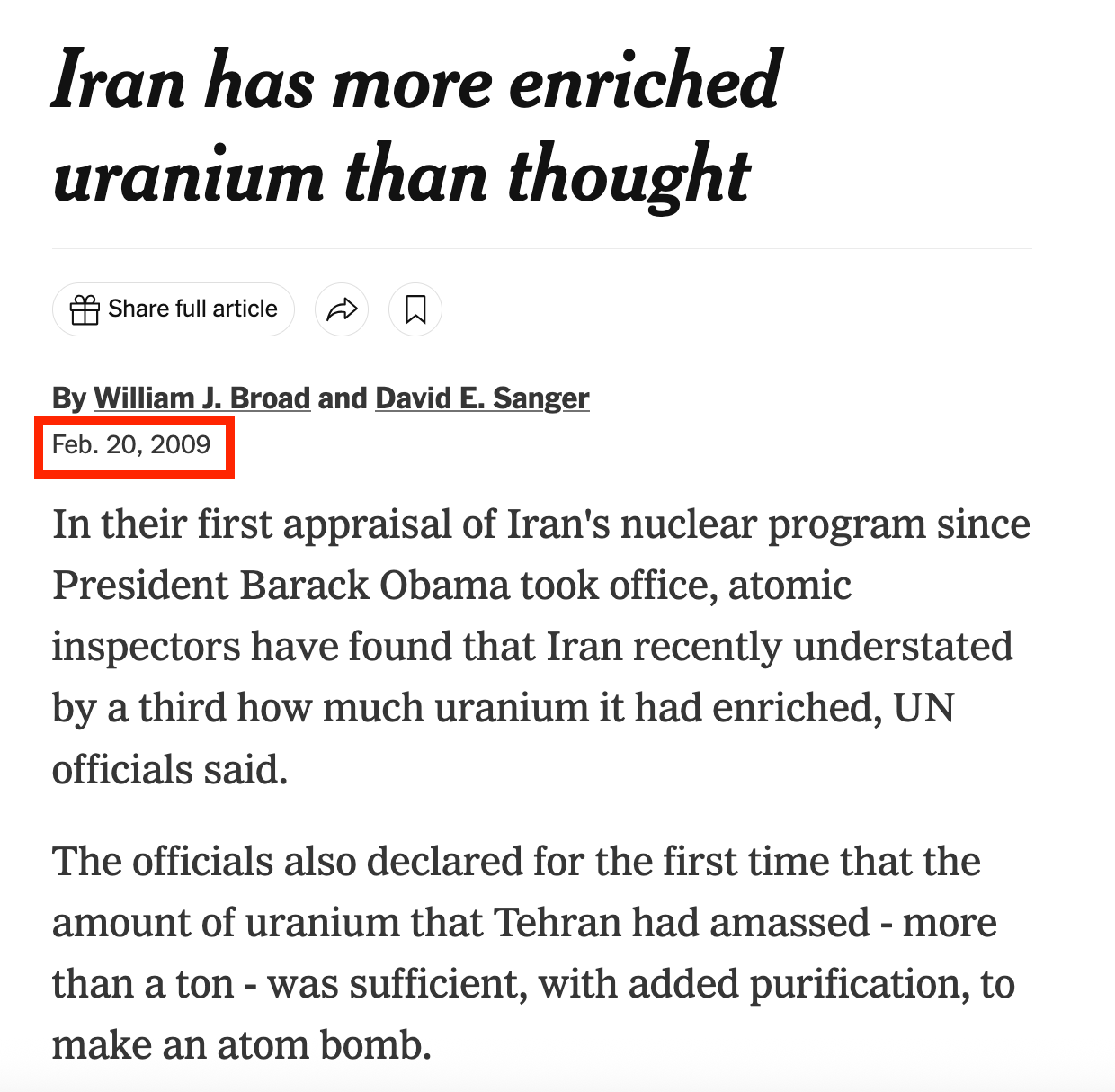
Iran could build a nuclear weapon if it wanted to. It could have built one as far back as 2009 had it been so inclined. And yet, it did not.
Note the date on the following headline:
So ludicrous are the rationales put forth by the war’s proponents, and so disastrous the potential consequences, that two things are clear.
First, the people who have been urging a US attack are full of shit.
Second, the only ones who stand to benefit are Benjamin Netanyahu, for whom the war serves as a personal vanity project and legal defense tactic, and the various warlords who would emerge in the wake of the Iranian regime's collapse.
How do I know this, you ask? Let's take a look.
Would any of these myriad disasters further the national interests of America or Israel? The question answers itself.
To start with the obvious, nobody, including the United States, is going to invade and conquer Iran.
An invasion from the east is impossible, as it would have to be launched from Afghanistan and in turn require the cooperation of the Taliban. Even then, the US would have to move an army across the eastern mountains and then through the vast deserts of Dasht-e Lut and Dasht-e Kavir.
Invading from the west is just as implausible, as it would mean traversing the towering Zagros mountain range. Those mountains, along with others, protect Iran’s Persian Gulf Coast stretching southeast toward the Gulf of Oman.
Meanwhile, the one part of the country that is not buffeted by mountains is comprised of impenetrable swampland.
Even if American forces somehow made it through Iran's imposing exterior, they would find an interior dominated by uninhabitable desert plateaus.
That is not to mention the challenges of invading and pacifying a country three times as populous as Iraq and with a territory larger than France, Germany, Spain, Portugal, Belgium, and the Netherlands combined.
All in all, it would necessitate a force of 1.6 million troops. By comparison, the highest number of US troops that were ever present in Iraq was 180,000.
In other words, an invasion is not happening.
Nuclear Resilience
If a ground invasion is out, that leaves an aerial assault like the one we just witnessed as the only option. But no such attack could permanently eliminate Iran's nuclear capability. While American bombs might have destroyed its existing nuclear infrastructure, the country still possesses the technological know-how to revive the program within a few years.
“Even if there was a complete destruction of all of Iran's enrichment capability,” explains Joe Cirincione, an expert on the country’s nuclear program, “when the war was over, Iran could start building it back up again.”
In fact, Trump's military intervention makes it more, not less, likely that Iran will develop nuclear weapons. The only reason the regime has not done so already is that it decided that the costs outweighed the benefits. Its goal all along was not to acquire a weapon but to be perpetually in the process of acquiring a weapon. This, as far as the regime was concerned, gave it the most leverage to compel America to remove sanctions while minimizing the possibility of a US attack.
But now that America has (supposedly) destroyed its nuclear facilities—a move which, again, only amounts to a temporary setback—the regime’s calculus will likely change. Since the US would not make a deal, Iran’s leadership might decide that the way forward is to obtain actual nukes.
This fact should be obvious to any reasonably intelligent and informed observer—someone, in particular, like Benjamin Netanyahu. And it probably is. Yet, he nonetheless went ahead with a plan that undermines his country’s national interests.
Collapse and Civil War
Another potential outcome of the war, especially if Trump launches more attacks, is the end of the Iranian regime. This would appear to be Netanyahu’s real aim.
But contrary to what Israeli and American officials would like you to believe, bringing down the regime would not benefit either country. While Trump might be too stupid to understand this, Netanyahu is not.
After all, we have a recent example of an American war that successfully brought about regime change in a Middle Eastern country. The 2003 invasion of Iraq did not produce a new and stable US ally but instead resulted in its violent collapse and the eventual rise of ISIS.
There is no reason to think that the attack on Iran will turn out any better. Far from it, in fact; the consequences might be orders of magnitude worse. The toppling of Saddam Hussein resulted in prolonged and violent conflict among Iraq’s Sunni, Shia, and Kurdish communities. Iran is divided along similar lines, with a Shia majority concentrated in the country’s center, a Sunni minority in the north, west, and southeast, and a Kurdish minority in the west and northeast.
There is only one person who will actually benefit from Trump's attack, and that is Benjamin Netanyahu.
But it gets even more complicated than that. In addition to those three groups, Iran is host to a number of others as well, including Azeris in the northwest, Arabs in the southwest, and Baloch in the southeast, to name a few.
Many of these minorities are resentful toward regime policies which have long favored the Shia Muslim and ethnic Persian majority at the expense of the others. Hence, if the regime does collapse, expect a complex and brutally violent civil war to break out as most if not all of these groups have a go at independence.
In a society as divided as Iran's, the collapse of the state can result in staggering levels of death and destruction. The reason is that rival communities start operating according to a “kill them before they kill us” logic.
That is not all, however. Aside from sectarian and ethnic violence, the country could witness a separate war between rival elite factions from the old regime.
Nor would the effects of a civil war be limited to Iran. Such conflicts tend to destabilize neighboring countries, too. For one thing, they trigger the large-scale exodus of refugees. For example, as Shia refugees pour into Iraq, it would upset that country’s own sectarian balance and tip it back into civil war. The same could happen if masses of ethnic Kurds take refuge in Turkey and Iranian Azeris move into Armenia and Azerbaijan.
But refugee crises are not the only way in which an Iranian civil war would affect its neighbors. The sight of ethnic and sectarian bloodshed in Iran would cause dangerous tensions between the same groups in other places.
If Kurds and Azeris start killing each other in Iran, it could lead to revenge killings between Turkey’s Kurdish and Turkish communities, the latter of whom regard Azeris as their own. Violence among Iran’s Sunnis and Shias could have the same effect in Iraq, Syria, and Lebanon, all of which feature sectarian conflicts of their own.
Moreover, if the collapse of Iraq gave us ISIS, what new barbaric terrorist organization would Iran’s disintegration produce?
Oh, and let us not forget the hundreds of pounds of highly enriched uranium that could be sold on the black market in the event of a regime collapse and civil war.
Nice, huh?
What makes America's intervention even more destabilizing is its likely impact on the global supply of oil. One reason the US never attacked Iran before is the likelihood that the regime would retaliate by shutting down the flow of oil through the Strait of Hormuz— the 34-kilometer-wide waterway that connects the Persian Gulf to the Gulf of Oman and through which travels fully one-quarter of the world’s oil supply.
Which of these myriad disasters are you most looking forward to? An emboldened regime that doubles down on its quest for nuclear weapons? A collapsed regime that unleashes war, instability, and black-market uranium on the rest of the region? The oil shock that ensues either way?
Finally, would any of these things somehow further the national interests of America or Israel?
The question answers itself.
Damsel In Distress
There is only one person who will actually benefit from Trump's attack, and that is Benjamin Netanyahu.
You see, Netanyahu is in trouble. He has two problems, in particular. The first is his ongoing corruption trial, the outcome of which he wants to delay for as long as possible. The best way to do that is by staying in power, and to stay in power, he must keep initiating new crises and new wars—wars like the one he started with Iran.
Netanyahu's dependence on new wars stems from his second problem: October 7th, 2023. That day, as Hamas militants stormed out of Gaza and massacred scores of Israelis, the entire security paradigm he had painstakingly built throughout his time in power collapsed.
In the years leading up to the attack, he and his allies shifted their focus to annexing the West Bank, having convinced themselves that they had successfully pacified Gaza. This was a grave miscalculation on Netanyahu's part, one which put his legacy in jeopardy and raised the question of why he should remain prime minister at all.
To save himself, he needed redemption. His genocidal assault on Gaza’s Palestinians was one way of achieving this. More than a year and a half later, however, he is no longer getting the same mileage out of it that he once did.
In the meantime, he faces sagging approval ratings and rising opposition from within his ruling coalition. As a result, he stands on the precipice of losing power once again—or at least he did before he attacked Iran. Now, with his approval picking back up and his opponents rallying behind him, he might yet survive.
If the US intervention succeeded in destroying Iran’s nuclear assets and ends up bringing down its regime, Netanyahu might finally redeem his earlier mistakes and salvage his reputation.
This, after all, is the only reason we even got to this point—well, that and a weak American president who can be easily manipulated into doing stupid things. Let us hope that the worst fails to happen.
Weak American president? How about lying narcissist conman with daily worsening dementia. A Russian asset and most likely a too easy to blackmail pedophile. In essence, an absolute failure as a human being, let alone "leader" of anything except the group of syncophants holding his mirror
This is just dripping with anti-Semitic double standards, saved only for the Jewish state. Netanyahu is not string pulling the US into war with Iran. Jews are a successful minority, not a global kabal.
If you can’t acknowledge why the US would A) not want Iran to have a nuclear weapon, B) force regime change, at this point in time, for its own national interests, you’re seeing what you want to see.
It’s a nightmare regime run by Islamist fundamentalists. 100s if not 1000s of Americans have been killed in Iraq and across the world at Iran’s behest. Yemen is a hellish war zone because Iran plies it with weapons.
The Iranians and the Muslim brotherhood are cancerous fundamentalists trying to conquer the world through global jihad, starting with Israel because its infidels on “Muslim land.”
But, Iran openly and regularly chants Death to America and you think this is all about Israel? Who gave them the Shah?