

“I do not ask that you place hands upon the tyrant to topple him over, but simply that you support him no longer; then you will behold him, like a great Colossus whose pedestal has been pulled away, fall of his own weight and break into pieces.”
—Étienne de La Boétie, Discourse on Voluntary Servitude, 1577
Forty years ago this month, Filipinos came face to face with the machinery of death that once cowed and terrorized them.
Weeks earlier, Ferdinand Marcos, who for decades had ruled the country as his personal dominion, lost his bid for another presidential term. But he was determined as ever to remain in charge.
On February 23rd, 1986, a Sunday, he ordered his military to assault a band of renegade army officers holed up in a nearby base.
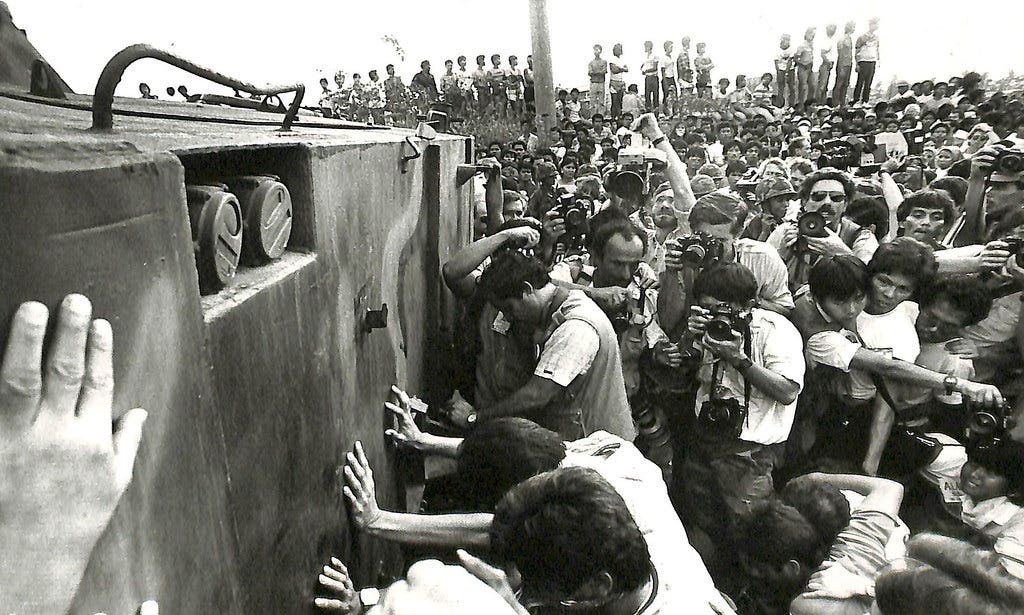
As his tanks rolled down Epifanio de los Santos Avenue in Manila, they came upon 20,000 Filipinos occupying the eight-lane boulevard, intent on stopping them from reaching their target. If previously, the people had trembled at the thought of resisting, now, they stood firm.
Amado Lacuesta Jr., a young screenwriter present near the front of the throng, described the encounter:
Panic sweeps over us all. Unthinking, I drop to my knees. Looking up I see only the general and his marines, disciplined, hard-eyed. … I shout and raise my hands, daring them: “Go on, kill us!” … The metal mountain jerks forward. Defiant, nervous shouts all around. The praying voices rise another key. I wonder what it is like to be crushed under tons of metal. Then the engine stops. There is an astounding split second of silence. The crowd erupts into wild cheers and applause.
Ordered to slaughter innocents, the troops had refused. “There were pregnant women and little children there that reminded us of our own families,” one soldier recounts. “I knew that if I didn’t clear the road and follow orders, I would be shot. But I also knew that if I did that, I would have to violate my conscience.”
The confrontation that Sunday was a critical moment, one of several which saw a bloody dictatorship dissolve in a matter of days.
In a test of wills, Filipinos had stared down a ruthless strongman—and won.
The Fortress and the Temple
It might seem counterintuitive to see dictators as vulnerable to the fickle allegiances of others. It is certainly not how dictators see themselves.
Conventional wisdom views power as a fortress—strong, fixed, and durable. A ruler has police and soldiers, and he1 uses them to exert his will upon society. The only way to thwart his power is to destroy it with superior force or take control of it in an election or coup.
But this is not how power actually works. Recall the example of Vidkun Quisling, the wartime Nazi puppet leader of Norway, whom I discussed in a previous essay. For all the terror he employed, he was unable to bring a bunch of recalcitrant schoolteachers into line.
The Norwegian teachers’ resistance lays bare the misconception behind the fortress view. In the absence of voluntary compliance, no amount of force can make someone obey another’s command.
Power, in other words, is not something that rulers have; it is granted to them by others.
Nonviolent action creates the opportunity—and, often, necessity—for the ruler’s supporting pillars to cut and run, leaving him bereft of the agents he depends on to wield control.
In this regard, power is more accurately viewed as a temple than a fortress. The Pantheon in Rome would not remain upright without the support of its columns, or pillars. Topple those pillars and watch it collapse.
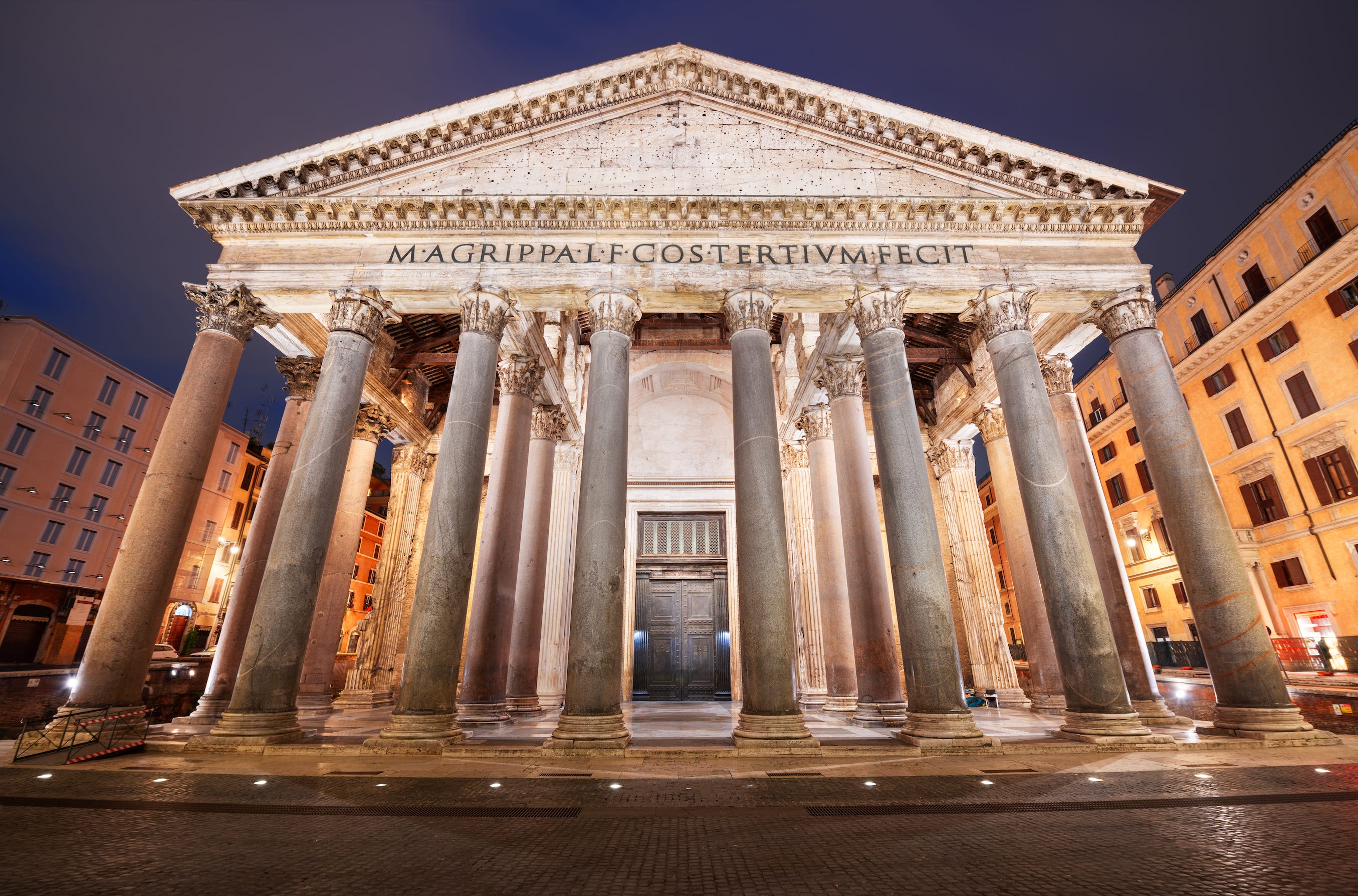
The model of a temple on pillars is useful, for it highlights just how brittle power can be. “When we say of somebody that he is ‘in power,’” notes Hannah Arendt in On Violence,
we actually refer to his being empowered by a certain number of people to act in their name. The moment the group, from which the power originated to begin with…disappears, “his power” also vanishes.
This principle applies regardless of whether the ruler operates in a democracy or dictatorship. Of course, given the dystopian hellscape in which the United States now finds itself, it is the dictator that most concerns us here.
Like any powerholder, a dictator requires the support of other elites. These elites serve as pillars that prop up his regime. The military and police are the most obvious ones. But other pillars can include prominent businesspeople, government officials, civil servants, pro-government parties, state media, religious authorities, and foreign allies.
Most dictators can withstand the loss of one or another pillar. Remove several, and he begins to sweat. Remove the army, police, and other armed elements, and he is finished.
The question, from the standpoint of his beleaguered subjects, is how to sweep those pillars away. There are several methods, not all of them desirable. For instance, a military coup removes a crucial pillar of support, but it might end up yielding a new dictator in place of the old.
If our goal is the return of democracy, then mass nonviolent action is the most effective means of getting it done. Protests, strikes, boycotts, and other forms of nonviolent resistance, if waged on a sufficiently large scale, call into question a dictator’s survival. At that point, the elites who serve as pillars of his regime might decide that it is time to abandon him.
When they do defect, it is rarely because they experience a moral revelation about how bad the dictator is. More often, their motivations are selfish. Some elites defect because they fear being held accountable if the regime falls. Others foresee an opportunity for advantage.
Whatever their agenda, the outcome is the same. Few dictators can survive the mass desertion of their elite supporters—and the best means of driving those elites away is through popular nonviolent resistance.
Nonviolent action creates the opportunity—and, often, necessity—for the ruler’s supporting pillars to cut and run, leaving him bereft of the agents he depends on to wield control.
The question of which model to adopt is hardly theoretical. For those living under authoritarianism, the implications are very real.
If we accept the fortress view, then there is little point in opposing the regime. Unless resisters can mount their own army, the dictator remains secure.
Embracing the temple view, by contrast, opens up a more liberating possibility: control of the ruler by the “withdrawal of consent.” As Gene Sharp explains:
It is control, not by the infliction of superior violence from on top or outside, not by persuasion, nor by hopes of a change of heart in the ruler, but rather by the subjects’ declining to supply the power-holder with the sources of his power, by cutting off his power at the roots. This is resistance by noncooperation and disobedience.
In addition to being accurate, the temple model has the complementary advantage of putting the people in the driver’s seat. Popular resistance erodes the foundation of the ruler’s temple, destabilizing its supporting pillars. Shake those pillars enough, and his power collapses.
Few cases better illustrate this dynamic than the downfall of Philippine strongman Ferdinand Marcos in February 1986.
The Conjugal Dictatorship
In the years following his initial election as president in 1965, Marcos did not especially stand out from his predecessors.
It was his reelection campaign in 1969 which first showcased the tyranny that was to come. As the campaign heated up, Marcos dispatched his thugs to terrorize the opposition and strong-arm election officials, making the contest the bloodiest to date.
The election presaged a dark turn in his presidency. As popular unrest spiraled and his popularity tanked, Marcos became increasingly despotic.
In 1972, he ripped away all democratic pretense by declaring martial law. Officially aimed at containing the growing communist insurgency, it was a convenient excuse to cancel the election slated for the following year, in which he faced near-certain defeat.
With martial law in effect, there would be no election to lose and no parliament or supreme court to meddle in his affairs. From now on, Marcos would rule by decree. He shuttered independent media and unleashed the military on activists, journalists, professors, and political rivals, jailing thousands in a matter of weeks.
Still, he had to somehow justify the shift to one-man rule, and propaganda alone would not suffice. Nor were ordinary Filipinos the only ones who needed convincing. As the Philippines’ most important ally, the United States had to be brought on board.
But how? If there were an emergency, perhaps—a crisis so grave as to be immune to conventional remedies—that would certainly do.
There was a problem, however: No such emergency existed. And so, Marcos invented one.
In the months before the declaration of martial law, downtown Manila was rocked by a series of bombings. The regime blamed the communist rebels. In truth, Marcos’s own agents were responsible.
The charade was enough to convince Filipinos—and, critically, Americans—to accept the new order.
By the early 1980s, however, the country had plunged into crisis. The foreign borrowing spree which kept the Marcos regime afloat had suddenly collided with plunging global commodity prices. The economy cratered. Poverty spiked.
Not everyone suffered, naturally. Marcos spent $3 billion on bailouts for his oligarch friends. For her part, Imelda Marcos, the first lady, was not about to skimp on her lavish shopping sprees in Paris and New York.
At a time of belt-tightening, such barefaced graft was sure to fuel resentment. But few Filipinos were prepared to brave the hazards of challenging the regime. As far as most were concerned, Marcos was protected by his army and police. Who, under the circumstances, would risk their necks by speaking out?
In this way, most of the public remained blinded by the fortress myth. “The regime lasted for twenty years,” observes Sterling Seagrave, a journalist, “only because
Filipinos allowed themselves to be convinced that the dictator was in firm control, that his secret police were everywhere, that his army was overwhelmingly powerful, and that Ferdinand Marcos himself was supernaturally endowed. These things were true up to a point. Beyond that, the impression of power and omniscience was exaggerated by showmanship and grotesque extremes of cruelty. Ordinary people were psyched out.
State intimidation was undoubtedly one of the keys to Marcos’s rule. During his twenty-year tenure, approximately 35,000 people were tortured and 70,000 arrested, historian Alfred W. McCoy estimates. Such was the barbarism of Marcos’s torture units that a new word entered the national lexicon: “salvaging,” or the disposal of mutilated corpses along roadsides for the purpose of sowing terror.
But as Seagrave notes, force alone was not enough to keep the people down. Equally important, and more cost-effective, was the belief in the ruler’s invincibility.
The veil, godlike though it seems, can be pierced in an instant.
The Marcoses wrapped their dominance in a shroud of performance and myth. Imelda hailed from one of the Philippines’ most noble houses. Ferdinand descended from great warriors. He was also an Olympic athlete. And he bravely led a band of guerillas against Japanese rule during the Second World War, in recognition of which he was awarded the Medal of Honor by Douglas MacArthur himself.
(In 1985, a rather inconvenient time for Marcos, a U.S. military investigation deemed his claim to have led a guerilla unit, much less receive a medal for it, as “fraudulent” and “absurd”).
Imelda claimed that General MacArthur had secretly adopted her as a young girl. That very same MacArthur carried on an illicit love affair with her aunt. (To a certain generation of Filipinos, MacArthur embodied a sort of hybrid between Alexander the Great and Taylor Swift.)
It was all bullshit, and most people knew it. But that was the point: Only those as omnipotent as the Marcoses could lie so brazenly without consequence.
The Marcos dictatorship was very much a family affair. Imelda represented the country on the international stage. Back home, she served as “minister of human settlements,” tasked with dispensing patronage to Ferdinand’s provincial allies.
For the ruling couple, the experience of martial law was like the “Push It to the Limit” montage in Scarface, if Florida were a nation-state ruled by Al Pacino and Michelle Pfeiffer. The misrule would have been comical if not for the human costs it entailed.
The Marcoses emptied an entire island of its inhabitants to make way for a private zoo complete with giraffes, zebras, and other wildlife imported from Kenya. Imelda lavished $31 million on a “grotesque guesthouse made entirely of coconuts.”
The presidential palace boasted an oversized painting featuring the ruling couple as the Filipino Adam and Eve, giving birth to the nation. According to Keith Dalton, a reporter who saw it first-hand, the portrait depicted a “muscular, bare chested, dagger-holding Marcos emerging from a bamboo jungle, and a half naked, long-haired, coy-looking Imelda modestly clutching a flowing white veil to her chest.”
While the dictator believes he resides in Dragonstone, events have a way of revealing otherwise—that he is really sitting on the roof of the Pantheon. The veil, godlike though it seems, can be pierced in an instant.
For the Marcoses, that moment came on August 21st, 1983.
Next time, an ill-advised assassination and the revolution it birthed.
SOURCES
Arendt, Hannah, On Violence (Orlando: Harcourt, 1970).
Burton, Sandra, Impossible Dream: The Marcoses, the Aquinos, and the Unfinished Revolution (New York, Warner Books, 1989).
Dalton, Keith, Reinventing Marcos: From Dictator to Hero, Revised Kindle Edition (Lightning Source Global, Amazon Publishing, and IngramSpark, 2025).
Forest, Jim and Nancy Forest, Four Days in February: The Story of the Nonviolent Overthrow of the Marcos Regime (Hampshire, U.K.: Marshall Pickering, 1988).
Karnow, Stanley, In Our Image: America’s Empire in the Philippines, Kindle Edition (New York and Toronto: Ballantine Books and Random House, 1989).
McCoy, Alfred W., “Dark Legacy: Human Rights Under the Marcos Regime,” (paper presented at the Legacies of the Marcos Dictatorship Conference, Ateneo de Manila University, September 20, 1999), http://www.hartford-hwp.com/archives/54a/062.html, accessed January 9, 2026.
Piatos, Tiziana Celine, “Flashback: Tide Turns at Revolt,” Daily Tribune, February 24, 2024, https://tribune.net.ph/2024/02/25/flashback-tide-turns-at-revolt, accessed February 5, 2026.
Seagrave, Sterling, The Marcos Dynasty, Kindle Edition (London: Lume Books, 2018 [1988]).
Sharp, Gene, The Politics of Nonviolent Action (Boston: The Albert Einstein Institution, 2006 [1973]).
Sharp, Gene, Waging Nonviolent Struggle: 20th Century Practice and 21st Century Potential (Boston: Extending Horizons Books, 2005).
Being that the intended lesson of this discussion involves the prospective overthrow of one particular dictator—the one who currently rules in the United States and who happens to be male—I will use the masculine “he” and “him” when referring to a generic dictator.